Travel Scooter vs. Power Wheelchair: Which Is Right for You?

Choosing between a travel scooter and a power wheelchair is one of the most common crossroads people reach when shopping for personal mobility. Both give you freedom, independence, and the confidence to keep doing the things you love. But they are designed for different bodies, different lifestyles, and different environments. Picking the right one comes down to understanding how you will actually use it day to day.
This guide walks you through who each device is best for, how they compare on indoor and outdoor use, transport and folding, range, and cost, so you can make a decision you feel good about. If you would rather talk it through with a real person, our US-based team is always happy to help you weigh the options.
The Short Version: What's the Difference?
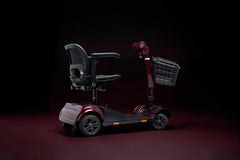
A travel scooter (sometimes called a mobility scooter) is steered with handlebars called a tiller and is operated by squeezing a throttle. You sit in a comfortable seat, and the scooter carries you forward. Travel scooters are built to be lightweight and, in many cases, foldable or easy to disassemble so they can go in a car trunk. They shine for people who can walk short distances but tire out over longer ones.
A power wheelchair is controlled with a joystick, usually mounted on the armrest, and is designed for people who need mobility support most or all of the time. Power chairs tend to offer more supportive seating, tighter turning for indoor spaces, and controls that require less upper-body strength and range of motion than a tiller.
Neither one is "better" in a vacuum. The right choice is the one that fits your body, your home, and the places you go. You can browse both categories in our mobility scooters collection as you read.
Who Each One Is Best For
Start by thinking honestly about your current mobility level and how it may change over time.
- A travel scooter is often the better fit if you: can walk short distances and transfer in and out of a seat on your own, have reasonable upper-body strength and hand function to steer a tiller, mainly need help covering longer distances (shopping trips, fairs, travel, museums, sightseeing), and want something you or a family member can lift into a car.
- A power wheelchair is often the better fit if you: need mobility support for most of the day, have limited upper-body strength or range of motion that makes steering a tiller tiring, need supportive, pressure-relieving seating, or spend a lot of time maneuvering in tight indoor spaces like hallways and bathrooms.
If your needs are somewhere in the middle, that is common. Many people also consider a power-assist option, which adds motorized help to a manual wheelchair. It can be a smart bridge for someone who wants to keep the low weight and familiarity of a manual chair but needs a boost on hills and long pushes.
Indoor vs. Outdoor Use
Where you spend most of your time is one of the biggest deciding factors.
Indoors
Power wheelchairs are usually the stronger choice for tight indoor living. Because they steer from the rear or mid-wheel with a joystick, they can pivot in small spaces, navigate doorways, and turn in a kitchen or bathroom more easily. Travel scooters have a longer wheelbase and a wider turning circle, which can make some homes feel cramped, though compact travel models still do fine in open floor plans.
Outdoors
Travel scooters are wonderful for getting out and about. They are stable, comfortable over sidewalks and smooth paths, and their tiller steering feels intuitive on longer outdoor outings. If your main goal is to reclaim shopping trips, farmers markets, the boardwalk, or theme parks, a travel scooter is often ideal. Many power wheelchairs also handle outdoor use well, but the classic travel-scooter use case is exactly this kind of on-the-go independence.
Transport and Folding
How you will move the device between your home and the places you go matters just as much as how it drives.
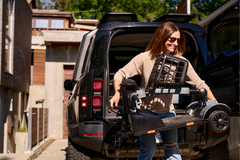
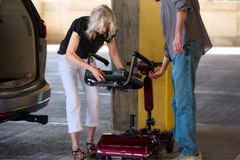
- Travel scooters are typically designed for portability. Many fold or break down into a few manageable pieces so they fit in a car trunk or SUV. Lightweight models are a favorite for people who travel, fly, or rely on a spouse or caregiver to load the device.
- Power wheelchairs vary widely. Some foldable power chairs are surprisingly travel-friendly, while heavier-duty models are meant to stay put or require a vehicle lift or ramp.
If you drive yourself, or the person helping you cannot lift much, prioritize weight and folding. A device that is too heavy to load is a device that stays home. Our compact Journey Lite aluminum power scooter is a good example of a model built around easy transport, and the full-size Journey offers a roomier ride for those who want a bit more.
Range: How Far Can You Go?
Range is the distance a device can travel on a single charge, and it depends on battery size, terrain, and rider weight. As a rule of thumb, lightweight travel scooters trade some range for portability, while larger scooters and power wheelchairs can offer longer range for a full day out.
Think about your typical outing. A trip around the neighborhood or a single store needs far less range than a full day at a fair or a large shopping center. When in doubt, choose a little more range than you think you need, so you are never watching the battery gauge instead of enjoying yourself. If you are unsure how a specific model's range fits your routine, message or call us and we will help you match it to real-life use.
Cost Considerations
Budget is real, and it is worth thinking about beyond the sticker price. A few things to keep in mind:
- Portability often lowers cost. Lightweight travel scooters tend to be among the most affordable powered mobility options, which is part of why they are so popular for first-time buyers.
- Seating and support add value. Power wheelchairs can cost more because of their advanced seating, joystick controls, and maneuverability, features that matter a great deal if you use the device all day.
- Factor in the whole experience. Fast, free US shipping, a straightforward 90-day return window, and manufacturer warranty coverage all protect your investment. So does knowing you can reach US-based support by phone or message if you have questions after it arrives.
Do not choose on price alone. The cheapest device that does not fit your life costs more in the long run than the right device that serves you for years.
How to Decide
Bring it together with a few honest questions:
- Can I walk short distances and transfer on my own, or do I need support most of the day?
- Do I mostly need help outdoors and on longer distances, or indoors in tight spaces?
- Will I load this into a car, and can I (or my helper) manage the weight?
- How far do I typically travel in a day?
- What total budget feels comfortable, including the peace of mind that comes with returns, warranty, and support?
If you lean toward walking short distances, getting out and about, and easy transport, a travel scooter is likely your match. If you need all-day support, supportive seating, and tight indoor maneuverability, a power wheelchair is probably the better call. And if you love your manual chair but want a boost, explore power-assist.
Still weighing affordability and portability? Our companion guide, Best Lightweight Mobility Scooters Under $1,000, breaks down what to look for in a budget-friendly, easy-to-transport scooter.
Ready to Find Your Fit?
You do not have to figure this out alone. Browse our full lineup in the mobility scooters collection, and when you are ready, message or call our friendly US-based team. We will listen to how you plan to use it and help you choose with confidence, backed by fast free US shipping, a 90-day return window, and manufacturer warranty coverage. Your next chapter of independence is closer than you think.